


The most important information about the museum in English.
The Museum in Koszalin is located at 37-39 Młyńska Street, right next to the picturesque Park of the Pomeranian Dukes and just steps away from the historic remains of the city walls.
The main entrance to the museum is located at the intersection of Młyńska and Podgrodzie Streets.
Visitors to the Museum in Koszalin have access to two nearby free parking areas:
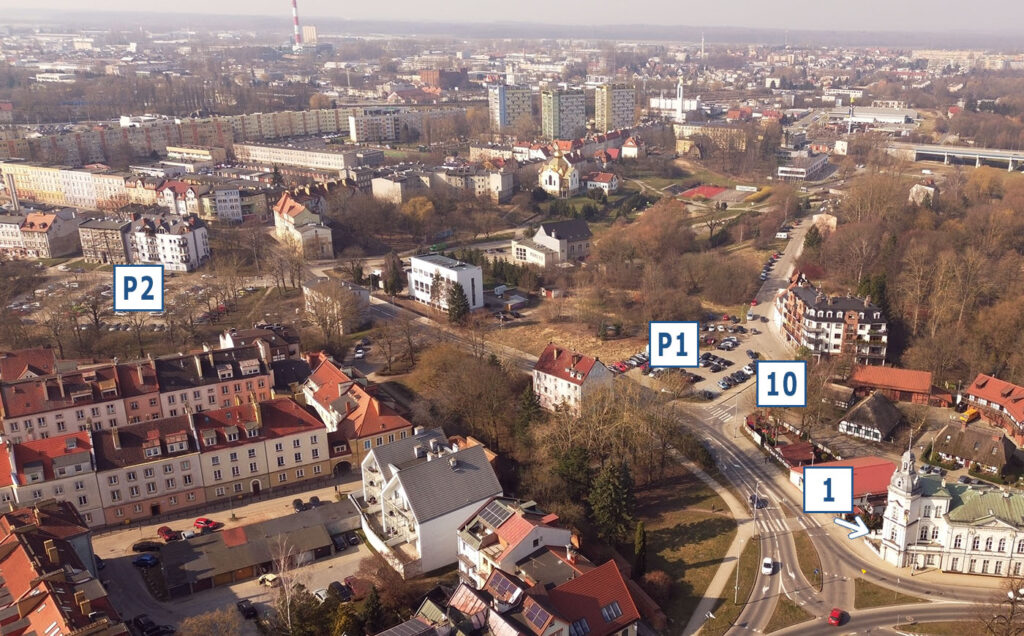
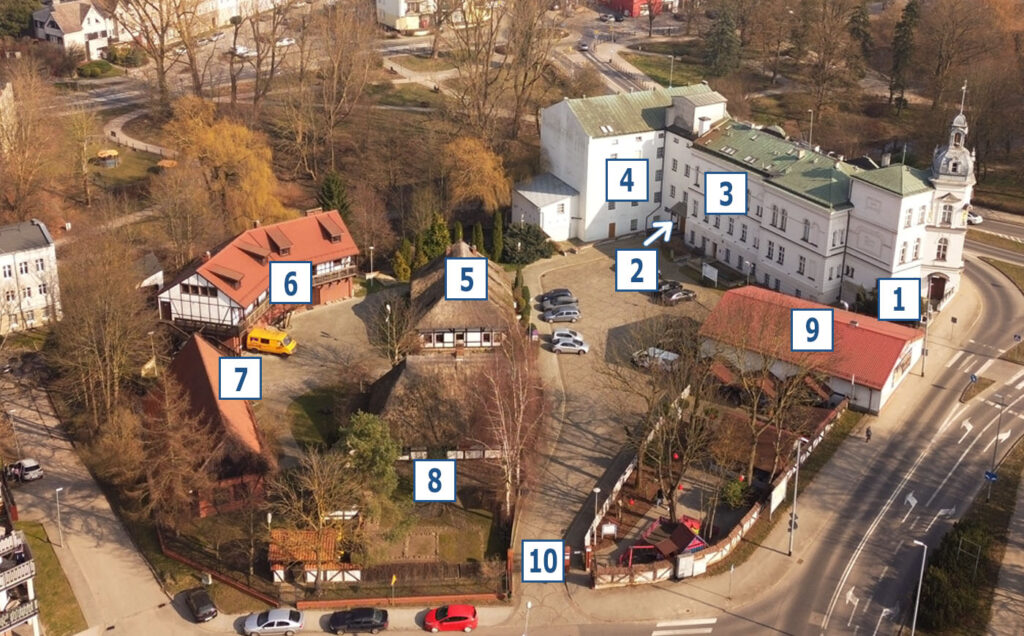
Explanation of the above photos:
Muzeum w Koszalinie
ul. Młyńska 37-39
75-420 Koszalin
Office
(94) 343 20 11
sekretariat@muzeum.koszalin.pl
The year 1912 is considered the beginning of museology in Koszalin; it was then, when the German Land and Country Defence Society organised the first exhibition in the town hall. Two years after that, on the Society’s initiative, the Heimatmuseum received its first premises in today’s Szpitalna Street, from where it was moved in 1929 to a building in today’s Marszałka Józefa Piłsudskiego Street. On 15 June 1947, a Polish museum was opened in the same place, partly based on the collection of the Heimatmuseum. The Museum went through different courses of its history (acting, among other things, as a branch of the National Museum in Szczecin, and later as a branch of the Museum of Central Pomerania in Słupsk), changing names (the Museum of Archaeology and History, the District Museum), as well as premises. Today, the Museum in Koszalin occupies premises at 37-39 Młyńska Street in a former mill building and an adjacent representative classicist-style tenement house, erected at the end of the 19th century by the mill’s owner Carl Gellert. A spectacular staircase with a tower was added to the building in 1913 in an attempt to give it the features of an urban residence. Today it adjoins new buildings on the museum’s premises, as well as an open-air museum – a fisherman’s hut relocated from the village of Dąbki.
The five departments of the Museum: Contemporary Art, Ancient Art, History, Archaeology and Ethnography take care of precious artefacts and art works, not only from the Pomeranian area. The collection of the Museum comprises of more than 45 000 specimens. The Museum organises science conferences and archaeological research, educational classes and open-air events.
Unfortunately, neither the original interiors of the Gellert House nor its furnishings have survived to the present day. It was decided that instead of creating a mock-up of the miller’s residence, a simulation of residential interiors in various styles would facilitate our visitors to develop an idea of changing fashions and tastes, as well as permit the presentation of at least a part of the collection of our furniture, painting, sculpture and handicrafts. Thus, the “Old Art and Crafts from Baroque to Art Nouveau” exhibition is housed in several rooms. Two of them – the „red” rooms – feature furnishings from the Baroque period (17th and 18th centuries), while the „blue” room presents the Empire style (1800-1815); subsequently, the visitor can continue through the dark-green interior, furnished in the comfortable, robust but also full of charm Biedermeier style (1815-50), through the „yellow” living room from the stately Historicist period (the second half of the 19th century), to end their walk in the „light green” Art Nouveau, like the fresh and light colours of spring, full of floral ornaments. It is worth taking this walk to imagine what it used to be like to live here, and to submerge oneself in the atmosphere of times gone by, if only for a moment.
The largest collection of the Museum in Koszalin consists of archaeological artefacts. About 12 000 years ago, the ice sheet finally receded from the area of today’s Pomerania, so conditions enabling the development of settlements appeared. Over the millennia, human civilisation slowly evolved here: from the first peasants – builders of mysterious megalithic tombs, through the blacksmiths of the Bronze and Iron Ages, then the Goths who left behind stone circles and burial mounds, the Slavs – building huge defensive strongholds, to the Middle Ages – the era of the first cities, monasteries and castles. At our “Pomeranian Prehistory” exhibition we present a unique Mesolithic ornamented hoe and a set of stone axes, made with extraordinary artistry. What also makes a big impression is a facial urn from 3000 years ago – a kind of coffin portrait in a surprisingly abstract style. The necklaces of glass beads and fibulae, for which the Romans who arrived here would buy the Baltic amber, so prized in the Empire, from the barbarian tribes, are precious ornaments that would still be eagerly worn even today. Gold fibulae and jewellery from the time of the Goths, as well as an early Mediaeval spearhead, decorated with a silver image of the Tree of Life, are particular highlights of our exhibition.
The majority of ancient societies did not leave any written material behind but only artefacts, which are now found during excavations; however, from these which we can read more than from many a book.
The exhibition “Pomeranian Everyday Life in the Mid-20th Century” is not only a history lesson, but also an atmospheric journey into the past, an encounter with objects from different worlds. After 1945, there was a population exchange in Pomerania – those expelled were replaced by others forced to look for a new „small homeland”. Arriving with modest possessions, they took on the challenge of combining them with the goods left behind by the previous owners, often with unknown functions. This exhibition is presented in the cottage of a fisherman’s homestead from the village of Dąbki, which was moved onto the museum premises in 1983.
A second building of the same homestead features a “Shoemaker’s Workshop” – a reconstruction of the facility with its full furnishing from the early 20th century.
A barn from the village of Paproty houses another permanent exhibition entitled “Pomeranian Smithy”; full of fascinating tools, the exhibition illustrates technological thinking of Pomerania from the mid 19th to the mid 20th centuries.
Folk culture, which developed in the villages of Jamno and Łabusz near Koszalin, already fascinated German researchers, and after the war it also became an object of interest for Polish ethnographers. Only recently have we been able to present it in its „cradle”, i.e. Jamno, which in 2010, together with Łabusz, was incorporated into the borders of Koszalin.
The Jamno Farmstead complex, opened in 2019, consists of two buildings: a cottage and a barn, which are reconstructions made on the basis of inventory sketches from 1927. The interior of the cottage is filled with original Jamnese furnishings, dating back to the turn of the 19th/20th century and sometimes as far back as the 18th century. They „tell” the story of how the former inhabitants of Jamno and Łabusz lived. The other reconstructed building is a barn, which only in its shape and construction refers to the original from 1765. The interior layout is adapted for educational functions.
The Farmstead accommodates workshops related to Jamno culture, ritual visual arts, related to Christmas and Easter, as well as classes in the ceramics workshop. They are based on old handicraft techniques such as embroidery, polychrome, woodblock printing and weaving. The Museum conducts lessons on life in the former Jamno. A series of scholarly sessions, under the common denominator “Jamno Seminars”, is dedicated to scholars of folk culture, as well as to all its admirers.
Four times a year, the Jamno Fair is organised at the farmstead – it is a bustling and colourful event, organised „on a folk note”, exceptionally loved by Koszalin denizens and tourists.