




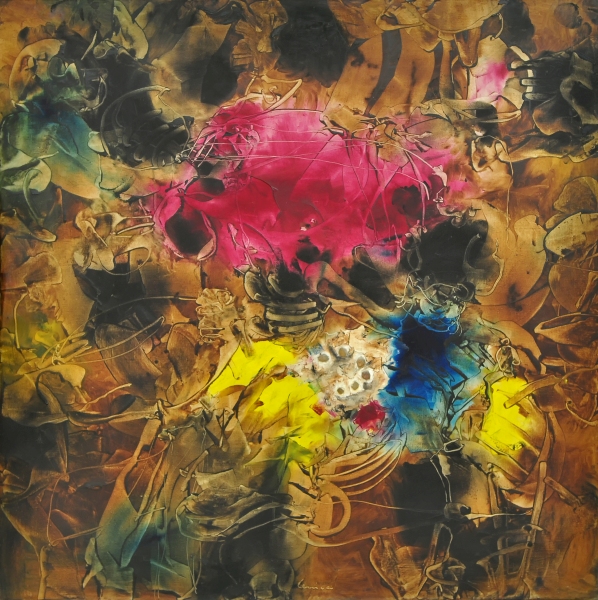
Alfred Lenica
Bez tytułu, 1963
olej, kamienie, płótno
własność Muzeum w Koszalinie
Obraz powstał podczas I Międzynarodowego Studium Pleneru Koszalińskiego w Osiekach (2–15 września 1963) i tym samym należy do grupy „prac założycielskich” kolekcji osieckiej. Stanowi wyjątkowy w twórczości Lenicy przykład dzieła o cechach asamblażu – pracy powstałej z przedmiotów trójwymiarowych lub ich fragmentów. Widoczne w środkowej części płótna kamienie zostały wyłowione z jeziora Jamno.
Dzieło reprezentuje dojrzały styl artysty. Lenica pod koniec lat czterdziestych, a potem od 1956 roku uprawiał informel – rodzaj abstrakcji bezforemnej, rozwijający się w krajach Europy Zachodniej pod wpływem egzystencjalizmu i antyhumanistycznych doświadczeń II wojny światowej. W Polsce ten typ abstrakcji stał się szczególnie popularny wśród artystów i artystek po politycznej odwilży 1956 roku jako formuła malarstwa nowoczesnego, zrywająca z ograniczeniami narzuconej twórcom przez władze doktryny realizmu socjalistycznego. W 1963 roku malowanie obrazów informelowych nie było już tak nowatorskie, jak w połowie poprzedniej dekady, nosiło jednak znamiona wywrotowe. W 1959 roku władze PZPR wydały zarządzenie zakazujące eksponowania na wystawach w miejscach publicznych więcej niż 15% abstrakcji. Uprawianie sztuki nieprzedstawiającej było więc od tego czasu formą oporu wobec odgórnych nakazów polityki kulturalnej PRL-u. W realiach reglamentowanej wolności artystycznej zorganizowano pierwszy plener osiecki, potocznie nazwany „nieoficjalnym zlotem abstrakcjonistów”. Aspekt wolnościowy stał się więc fundamentem zapoczątkowanej w 1963 roku imprezy artystycznej, a obraz Lenicy jest jedną z jego manifestacji.
Abstrakcyjne malarstwo artysty czerpie z poetyki nadrealizmu. Kojarzy się z surrealistycznymi technikami automatyzmu, czyli spontanicznym kształtowaniem materii odzwierciedlającym stan psychiczny autora, oraz dekalkomanii – rozciskaniem rozlanej farby między dwiema warstwami papieru. Farba na płótnie układa się w znaki rozwibrowanej i bezkształtnej materii uwolnionej z formy. Ziemiste kolory i kamienie nadają kompozycji wymiar geologiczny, odsyłając do pojęć pramaterii, pozaludzkiej pamięci miejsca, przemiany i płynności.
In English
Alfred Lenica
Untitled, 1963
oil, stones, canvas
property of the Museum in Koszalin
The painting was created during the 1st International Koszalin Plein Air in Osieki (2-15 September 1963) and thus belongs to the group of “founding works” in the Osieki Collection. It is a unique example of Lenica’s oeuvre – a work with assemblage characteristics, created from three-dimensional objects or their fragments. The stones visible in the central part of the canvas were fished out of Lake Jamno.
The work represents the artist’s mature style. In the late 1940s and then from 1956 onwards, Lenica worked with art informel – a type of formless abstraction, developing in Western European countries under the influence of existentialism and the anti-humanist experience of World War II. After the political thaw of 1956, this type of abstraction became particularly popular among artists in Poland as a formula for modern painting, breaking with the limitations of the doctrine of socialist realism imposed on artists by the authorities. In 1963, although informel painting was no longer as innovative as it had been in the middle of the previous decade, it did bear the hallmarks of subversion. In 1959, the Communist Party authorities issued an order limiting public exhibitions to a maximum of 15 per cent abstract art content. From then on, nonrepresentational art became a form of resistance to the top-down dictates of communist cultural policy. In the realities of regulated artistic freedom, the first Osieki plein-air workshop in 1963, colloquially known as the ‘unofficial abstractionist rally’, was organised. Artistic freedom thus became its founding principle, and Lenica’s paintings one of its manifestations.
Lenica’s abstract painting draws on the poetics of surrealism. It is associated with the surrealist techniques of automatism, i.e. the spontaneous shaping of matter reflecting the artist’s mental state, and decalcomania, the squeezing of spilt paint between two layers of paper. The paint on the canvas is arranged in signs of vibrated and shapeless matter freed from form. Earthy colours and stones add a geological dimension to the composition, referencing notions of primordial matter, extra-human memory of place, transformation and fluidity.