




Wacław Twarowski
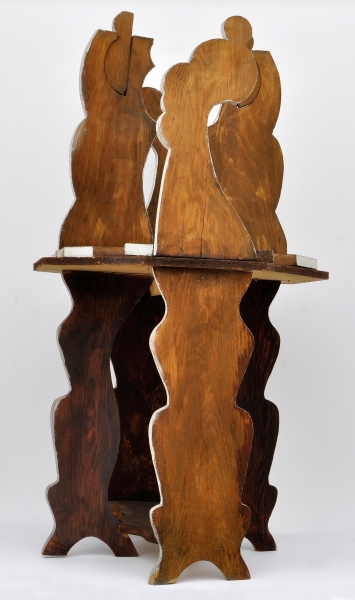
Stół, 1978
farba, drewno
własność Muzeum w Koszalinie
Artysta studiował w Królewskiej Akademii Sztuk Pięknych w Rzymie, Technical Institute w Londynie, Państwowej Szkole Sztuk Plastycznych w Poznaniu oraz Szkole Inżynierskiej w Poznaniu, dzięki czemu uzyskał wszechstronne wykształcenie pozwalające mu łączyć w swoich dziełach zagadnienia z obszaru sztuki i nauk ścisłych. Jako rzeźbiarz Twarowski eksperymentował z drewnem, metalem i tworzywami sztucznymi, a jako malarz wierny był poszukiwaniom kolorystycznym, wywodzącym się z postimpresjonizmu, szczególnie ceniąc dorobek Henriego Matisse’a. Jego obrazy i rzeźby przypominają architektoniczne konstrukcje, scalające fragmenty w zespoły sprawiające wrażenie tymczasowej stabilności i zagrożenia rozpadem i przywodzą na myśl witraże, które wykonywał w latach pięćdziesiątych.
Stół łączy w sobie masywną surowość i szorstkość drewna z obłością łagodnych form podmalowanych białą farbą na krawędziach. Z odmiennych punktów widzenia rzeźba zyskuje w percepcji różne wolumeny. Staje się ciężka, gdy pionowe elementy postrzega się jako płaszczyzny, a nabiera lekkości, kiedy formy zostają sprowadzone w oglądzie do białych linii. Praca zawiera fragmenty ruchome, wsunięte w górną partię i między szczeliny blatu. Całość stanowi rodzaj układanki zapraszającej widzów do interakcji, obecnie – z przyczyn konserwatorskich – już tylko wyobrażonej. Elementy pionowe przypominają formy roślinne i antropomorficzne, zdające się wyłaniać i niknąć w trakcie obchodzenia rzeźby. Symetryczne usytuowanie blatu względem pionowych fragmentów sugeruje motyw odbicia, zgłębiany przez artystę zwłaszcza w jego pracach świetlnych. Pionowy układ całości przywodzi na myśl ludzką sylwetkę i pozwala wyobrazić sobie rzeźbę jako rodzaj preorganicznego szkieletu oczekującego na obrośnięcie ciałem.
In English
Wacław Twarowski
Table, 1978
paint, wood
property of the Museum in Koszalin
The artist studied at the Royal Academy of Fine Arts in Rome, the Technical Institute in London, the State School of Fine Arts in Poznań and the Engineering School in Poznań, thanks to which he acquired a versatile education enabling him to combine issues from the fields of art and science in his works. As a sculptor, Twarowski experimented with wood, metal and plastics, and as a painter he was faithful to the search for colour, originating in post-impressionism, valuing the work of Henri Matisse, in particular. His paintings and sculptures, which recall the stained glass windows he made in the 1950s, are reminiscent of architectural constructions, integrating fragments into assemblies that convey an impression of temporary stability and the threat of disintegration.
Table combines the massive rawness and roughness of wood with the edginess of soft forms painted with white paint on the edges. Viewed from different perspectives, the sculpture takes on different volumes. It becomes heavy when the vertical elements are perceived as planes, but takes on a lightness when the forms are reduced to white lines in the viewing. The work contains moving fragments, inserted into the tabletop and between its slots. The whole is a kind of jigsaw puzzle, inviting the viewer to interact, though now, for conservation reasons, only in an imagined form. The vertical elements are reminiscent of plant and anthropomorphic forms, and seem to emerge and disappear as the viewer walks around the sculpture. The symmetrical positioning of the tabletop in relation to the vertical fragments suggests the motif of reflection, which the artist explored in his works with lights. The vertical arrangement of the whole brings to mind a human silhouette and allows us to imagine the sculpture as a sort of pre-organic skeleton waiting to grow a body.